The era of sitting before a piano teacher every week to have the same finger posture corrected is fading. In-person lessons won't disappear entirely, but in an environment where anyone can practice with a smartphone at any time, "fix this section next week" is a week-long feedback cycle that simply can't compete. The new standard in music education is a system that identifies why a learner makes a mistake in the moment it happens, and delivers a personalized response instantly.
The 1-on-1 Effect — Why AI Matters
Educational psychology confirmed this decades ago. Bloom (1984) identified the "2-sigma effect": students who receive one-on-one tutoring outperform classroom students by an average of two standard deviations — placing them at approximately the 98th percentile.
The problem is cost. Daily 1-on-1 lessons from a professional teacher are out of reach for most learners. That's where Intelligent Tutoring Systems (ITS) enter. Kurt VanLehn's (2011) meta-analysis confirmed that ITS produces roughly a 0.76σ improvement over classroom instruction. It doesn't match full human 1-on-1 tutoring (2.0σ), but given availability and cost, the number is revolutionary.
The same logic applies directly to music education. In sight-reading, every learner has different weak spots: some struggle with ledger lines, some with rhythm subdivision, some with sharps and flats. Capturing these differences without a teacher requires data.
Knowledge Tracing — Learning State as a Number
Knowledge Tracing is a methodology for continuously estimating the probability that a learner "knows" a particular concept or skill. Corbett and Anderson (1994) formalized it based on ACT-R theory; it has since evolved into Bayesian Knowledge Tracing (BKT) and deep learning variants (Deep Knowledge Tracing, DKT).
The core idea is simple: even when a learner answers correctly, the model must distinguish between genuinely knowing the answer and guessing. BKT uses four parameters to achieve this:
- P(L₀): Prior probability of knowledge before any practice
- P(T): Probability of acquiring the skill in a single learning opportunity (transition probability)
- P(G): Probability of guessing correctly without knowing
- P(S): Probability of answering incorrectly despite knowing (slip)
Applied to note sight-reading: three consecutive correct answers for "F#4" don't necessarily mean the learner knows the note. If the response time is two seconds, they're likely counting lines on the staff. Tracking response time alongside accuracy gives a far more precise estimate of true mastery.
Personalized Pathways — Same App, Different Curricula
The heart of data-driven personalization is dynamic adjustment of the learning path. Traditional music method books are linear: C major → G major → F major. But if Learner A has mastered C major yet struggles with F# in G major, they need an interpolated sequence drilling sharp notes before entering G major.
This is what the next generation of music learning apps must do in real time. The mechanism:
- Fine-grained skill decomposition: Not "piano playing" but "recognizing C4 instantly," "processing dotted rhythms," "handling a third leap" — hundreds of micro-skills
- Weakness detection: A knowledge tracing model for each micro-skill computes weak spots in real time
- Optimized problem selection: Selects the next problem that maximizes expected learning gain given the current knowledge state
Two learners using the same app will experience completely different practice sessions as a result.
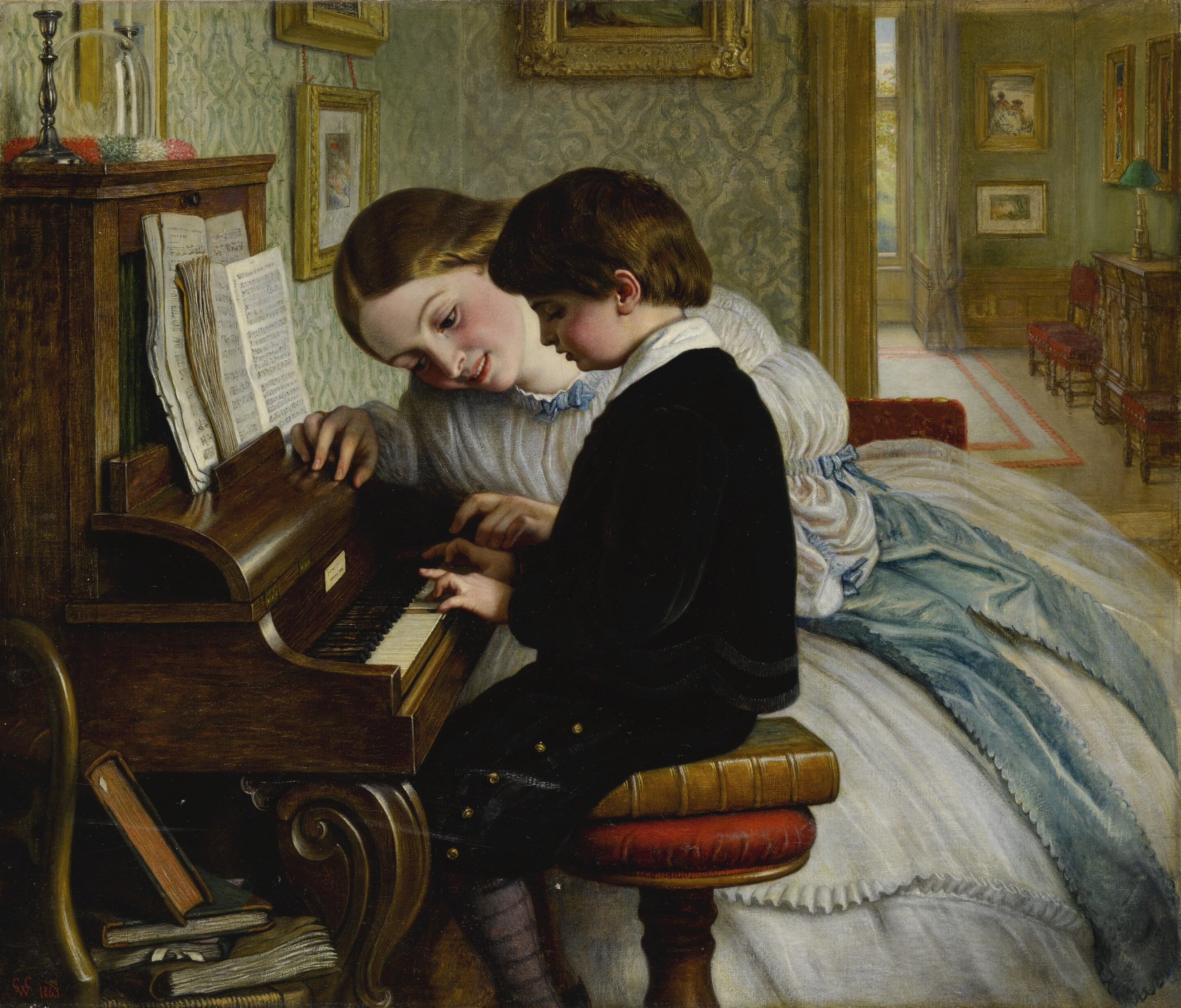 Charles West Cope, 〈The First Music Lesson〉, 1863. 19th-century music education depended entirely on the teacher-student 1-on-1 relationship. AI-driven personalization aims to recreate that structure without the cost barrier. Public Domain via Wikimedia Commons.
Feedback Loop Speed Is Everything
In a traditional lesson, the feedback cycle is one week. A bad habit has seven days to solidify before it gets corrected. In an app environment, this cycle compresses to milliseconds. When a note is misread, immediate feedback is possible.
But the speed of feedback matters as much as its content. Research consistently shows that elaborated feedback — explaining why an answer was wrong and how to fix it — produces far better long-term retention than simple right/wrong signals. Tomorrow's music apps won't just flash red or green: they'll analyze the pattern of errors and surface a specific corrective direction.
The math compounds quickly. Fifteen minutes of daily practice sustained for a month: when the feedback cycle drops from one week to immediate, the cumulative number of corrections theoretically increases more than tenfold. This is the core argument for app-based learning as a complement to traditional lessons.
Three Conditions Any Serious App Must Meet
Every music learning app claims AI personalization, but meaningful personalization requires three concrete capabilities:
1. A sufficiently fine learning graph Skills must be decomposed at the level of individual notes (pitch × octave ≈ 88 nodes), rhythm patterns, and interval types — not just "beginner piano." A single variable per learner makes real personalization impossible.
2. Response time measurement Accuracy alone overestimates mastery. Getting a note right in two seconds is a different cognitive state from getting it right in 0.3 seconds. Tracking response speed enables measurement of automaticity — the point at which recognition is truly effortless.
3. Spaced repetition integration Without a mechanism that schedules review based on the forgetting curve, a note perfectly mastered today will feel unfamiliar two months later. The spacing of repetitions is critical for converting short-term gains into long-term memory.
The Competitive Landscape Is Shifting
The trajectory that Duolingo traced in the language learning market is now playing out in music education. Duolingo reset the standard for educational apps by building a data-personalized repetition loop. In music, the standard will shift from "apps that display sheet music" to "apps that track learning state and design the next session." The apps that win this transition will combine two things: deep domain expertise (how musical skills decompose) and command of learning science (knowledge tracing, spaced repetition, feedback design). Either alone produces only half of real personalization.
This is why Noteflex tracks both response time and accuracy simultaneously, computes a per-note mastery score, and uses N+2 re-presentation logic to insert a review just before forgetting occurs. Every session data point is an input that refines the knowledge state estimate. The future of music education isn't more sheet music — it's a better data loop.