A guitarist looking at a piano score for the first time often feels disoriented. The job is to figure out which pitch this dot represents — a question guitar reading rarely demands. A pianist looking at guitar tablature has the opposite experience. There are numbers on lines, but they don't behave like notes. They tell you where to put a finger, not what to hear.
Same music. Two completely different ways of writing it down. The split isn't accidental. Each notation system grew out of the physical structure and performance logic of its instrument. Put them side by side and the differences make sense — and they reveal something useful about how each instrument shapes the reading brain.
Two different starting problems
Standard staff notation traces back to 11th-century Italy, where the monk Guido d'Arezzo formalized a four-line staff for chant. The goal was abstract pitch representation. A monk in one monastery should be able to sing the same melody as a monk in another, with no reference to any specific instrument. The notation was a blueprint of the music, not the player's hands.
Tablature evolved later, in the 14th and 15th centuries, among lutenists and viol players. Its starting problem was the opposite: how do I tell another lutenist exactly which string and which fret to press? Tablature doesn't describe pitch in the abstract. It describes physical action. The sound that results is a consequence, not the message itself.
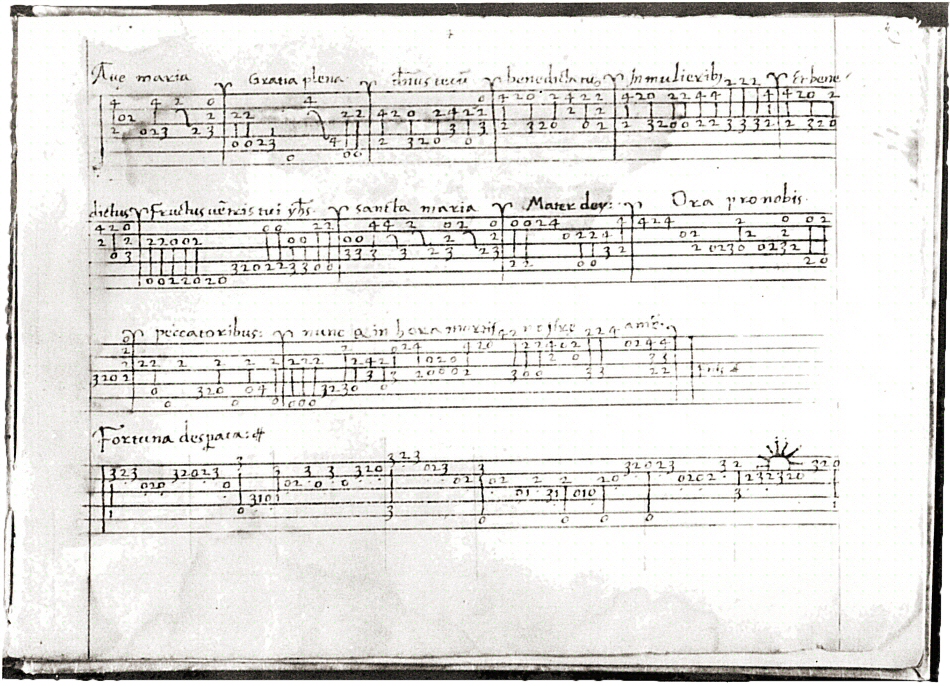 Lute tablature, 1521. Wikimedia Commons, Public Domain.
That starting-point divergence cascades into nearly every other difference between the two systems.
Difference 1 — Pitch versus position
A note on a staff says: produce this pitch. Where on the instrument you produce it is the player's decision. The pitch C5 can be played on a piano at one specific key, but on a guitar at five or more different positions — and the staff doesn't care which.
A number in TAB says: press this string at this fret. The pitch is whatever results. Two ways of producing the same pitch are written differently in TAB.
The downstream consequences:
- Staff readers go pitch → position every time. Recognizing that the dot is on the second space and means C requires one step; getting the hand to that pitch requires another. Two stages, every note.
- TAB readers go symbol → position directly. The number on the third string at fret 2 sends the finger there immediately. The reader may not even know the pitch.
The first is closer to musical thinking; the second is closer to motor learning. Neither is wrong. Lutes had as many as twelve strings in various tunings, with the same pitch available at multiple positions. Position-based notation was efficient there. The piano has every pitch at exactly one location, so pitch-based notation is efficient.
Difference 2 — Writing polyphony
The piano routinely plays multiple voices simultaneously across two hands. The grand staff was designed precisely for this. The right-hand melody and left-hand bass align vertically on the page, making it visually obvious what both hands play at each beat.
 Mozart's Piano Concerto No. 23 in A major, K. 488, autograph manuscript. Wikimedia Commons, Public Domain.
Guitars also play polyphony — fingerstyle and classical repertoire are full of it. TAB handles this through vertical alignment of numbers on different strings. Numbers stacked on the same vertical position are played together.
The contrast: the staff separates voices spatially (top staff = right hand, bottom = left). TAB integrates them temporally into a single grid. The staff makes hand assignment obvious but requires you to decode the pitch. TAB does the reverse.
Difference 3 — How precisely rhythm is encoded
Standard notation pins rhythm down with note shapes: stems, flags, dots. Eighths, sixteenths, dotted figures, triplets — each has a standardized symbol, and rhythm information is treated as equal in importance to pitch.
TAB has historically been weak here. Renaissance lute tablature used short stems above the fret numbers to indicate beat values, but the resolution was limited. Modern guitar TAB — especially the ASCII versions that circulate online — often carries little or no rhythm information. You have to already know the song to play it correctly. That's a real limitation.
For this reason, serious modern guitar instruction usually uses hybrid notation: a staff line with rhythm and pitch on top, and TAB below for fingering. It combines the precision of the staff with the directness of TAB. Each system fixes the other's blind spot.
Difference 4 — The cost of changing keys
Standard notation makes transposition expensive on the page. Move from C major to G major and every note shifts up a fifth, the key signature changes, every accidental gets reconsidered. Visually, it's a completely different page.
TAB makes transposition cheap. Add a capo, or use the same shape at a different fret. The page doesn't have to change at all. This is why guitar is so dominant in accompaniment — a guitarist can transpose on the fly to match any singer's range. The instrument and notation work together.
The piano runs the other way. Exact pitch is encoded, so a pianist can hear a new piece in their head before playing it. In solo classical repertoire, where transposition is rare, this is the more useful trade-off.
What this means for sight-reading
The two notation systems shape sight-reading strategy in different directions.
Piano sight-reading:
- Automate pitch recognition. Each staff position should map to its pitch instantly, with no conscious step.
- Hand position follows from pitch recognition. Calculating which finger goes where is the wrong layer to think on.
- Read the grand staff in chunks. Hand synchronization happens at the chord/measure level, not note by note.
- Pre-automate key signatures and accidentals so working memory has slack for what's actually new.
Guitar sight-reading:
- TAB readers go symbol → motor action without crossing pitch. That's efficient for performance but weak for sight-reading flexibility. Serious guitarists learn standard notation alongside TAB to build the missing layer of musical thought.
- A guitarist reading a staff has to memorize a larger pitch-to-position map (~72 combinations, 12 pitches × 6 strings) than a pianist (~88 unique keys, but each pitch appears once). The mapping is larger, but it's deterministic.
- Chord-chart reading is a different sight-reading skill entirely. The dominant pattern is harmonic-progression-first rather than melody-first.
What each tradition gives the other
Neither system is superior. Each one evolved to fit the physical reality of its instrument and the musical contexts where the instrument lives.
For players who cross instruments, recognizing what each tradition offers is the most useful frame. Piano-trained pitch automation transfers cleanly to reading staff notation on the guitar. Guitar-trained motor automation transfers usefully to piano hand-position learning. And the deeper skill — chunking, the ability to see patterns rather than items — develops faster in players who read both, because they've been forced to encode the same musical content in two different visual languages.
That cognitive flexibility is what sight-reading ultimately depends on. Knowing one system fluently is good. Knowing why two systems exist is better.