Sight-reading is the ability to perform music from a score encountered for the first time. For a long time the judgment was informal: a teacher listened, then offered a verdict. Translating that verdict into a usable number requires deciding what exactly to measure.
🎯 Pitch accuracy — the most direct metric
The starting point in most sight-reading assessment is pitch accuracy: the percentage of notes played that match the written pitch. Play 100 notes and get 84 right, and the score is 84 percent.
Simple to describe, harder to apply consistently. Decisions arise: does a correct pitch with the wrong rhythm count as an error? Does a wrong pitch that self-corrects within the phrase matter less than one that persists? Research studies handle this differently — some measure pitch and rhythmic accuracy separately, others use a composite score, and many add a fluency rating (whether the player continued without stopping) as a separate dimension.
Accuracy alone misses important information. Two players at the same accuracy percentage may be at different levels: one recovers quickly from errors without losing the pulse; the other stops briefly at each mistake and rebuilds. Where errors occur and what happens afterward is part of the picture that a single percentage does not capture.
⏱️ Response time — a measure of automatization
For tracking how well individual notes are processed, response time is a more sensitive metric than accuracy alone. A correct note identified in 0.3 seconds versus 1.8 seconds reflects a fundamentally different stage of processing, even though both count as correct answers.
A fast response means the visual pattern has been automatized — the brain recognizes the note position without active reasoning. A slow response means the reader is still in an active decoding stage, consciously working out the note's identity from position and clef. In real sight-reading, sections where tempo collapses tend to correspond closely to positions where response time is high.
Response time is also difficult to self-assess. By the time a reader registers that a note took long to identify, the moment has passed. External measurement is what makes this metric practical, and the data often surfaces weaknesses that the player had not consciously noticed.
👁️ Eye-hand span — a marker of expertise
Advanced sight-reading research often measures eye-hand span (EHS): how far ahead of the currently played note the reader's eyes are positioned. Skilled performers read multiple notes in advance, and they adjust the span based on musical structure — widening it through a stable melodic phrase, narrowing it at a phrase boundary or a technically demanding section.
Beginners tend to keep their eyes close to the note being played, leaving little or no predictive buffer. This is part of why early sight-reading feels reactive: the next note is never quite prepared for. As note recognition automates, mental resources free up and the span can grow.
Precise EHS measurement requires eye-tracking equipment and a controlled setup. As a rough practical indicator, noticing whether any forward reading happens at all distinguishes early-stage readers from those entering an intermediate range.
📊 What factors predict sight-reading performance
Mishra (2014) conducted a meta-analysis synthesizing 92 research studies on variables correlated with sight-reading accuracy. The strongest predictors were improvisational skill, ear-training ability, technical proficiency, and general music knowledge. Stable personal characteristics — personality traits and attitudes — showed no meaningful correlation.
The implication is that sight-reading is not purely a visual decoding task. Musical context shapes it substantially. Being able to anticipate likely note patterns, harmonic progressions, and rhythmic structures means that fewer notes need to be individually decoded; instead, they confirm or slightly modify an already-forming prediction. Strong ear training and music theory knowledge feed that predictive layer.
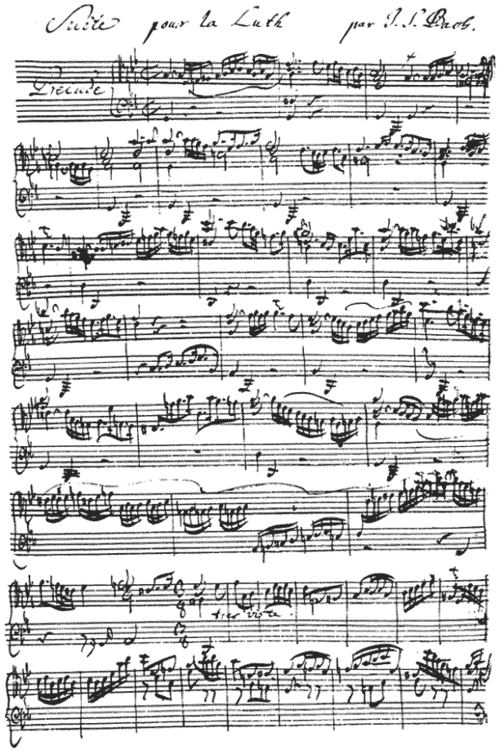 Figure 2: A Bach lute suite score. Reading complex polyphony at first sight draws on eye-hand span, musical anticipation, and rapid note recognition at the same time. Source: Wikimedia Commons / Public Domain
🔧 Self-measurement without specialized equipment
A practical approach to recording sight-reading performance without tracking tools:
Setup: Choose a score never practiced before. Familiar pieces involve memory retrieval and no longer test sight-reading. Set a metronome at a speed that allows continuous play, then read through once.
What to record:
- Pitch error count (and percentage of total notes)
- Rhythmic error count
- Number of stops or significant hesitations
One rule to keep: use each score only once for measurement purposes. Replaying the same piece introduces learning, and the first read is the only valid data point.
When accumulated over weeks, these numbers form a visible trend. The shift from subjective impression to a specific number is a modest change in habit — but it changes what gets noticed and where practice time goes. Targeted work on weak positions tends to be more effective than general repetition of the same material.