Sit at a piano and play C-D-E-F-G-A-B-C in order. Bright, clear, open — the sound rises like sunlight. Now drop the E, A, and B each by a half step and play C-D-Eb-F-G-Ab-Bb-C. Same starting note. Same ending note. The music is not the same. One feels like daylight, the other like dusk.
The difference between a major scale and a minor scale is not which seven note letters you pick. It is how the gaps between those notes are arranged. The same set of letter names can sound completely different if the spacing between them changes.
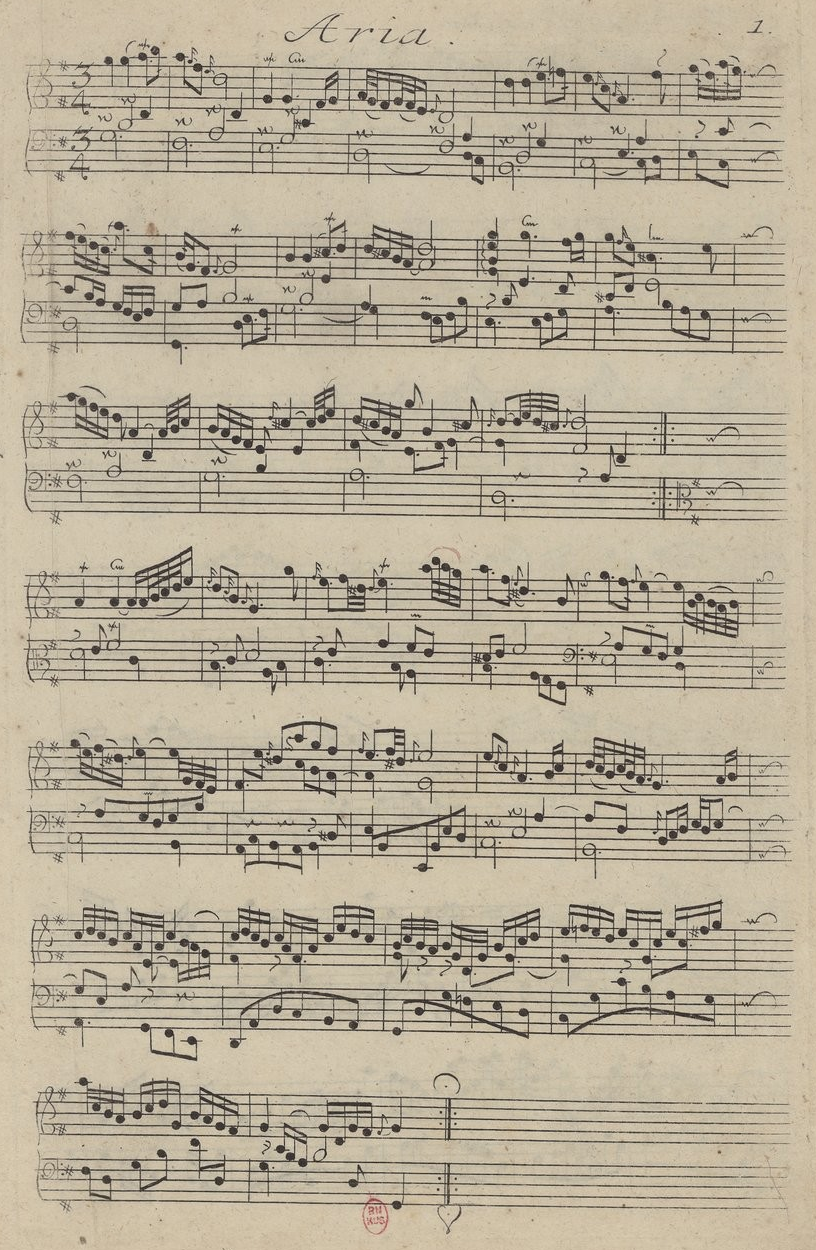
The first page of Bach's «Goldberg Variations» Aria, printed in 1741, begins on a G major scale. The right-hand line moves freely over G, A, B, C, D, E, and F-sharp. Why F-sharp and not F? Because the G major scale needs that sharp to keep its interval pattern intact.
The Major Scale Pattern
A major scale moves from its starting note to the octave above through a fixed pattern of intervals:
- whole — whole — half — whole — whole — whole — half
- abbreviated W-W-H-W-W-W-H.
The simplest example is the C major scale, played entirely on the white keys: C-D-E-F-G-A-B-C.
- C to D: whole step
- D to E: whole step
- E to F: half step (no black key between them)
- F to G: whole step
- G to A: whole step
- A to B: whole step
- B to C: half step
Apply the same W-W-H-W-W-W-H pattern starting on G and you get G-A-B-C-D-E-F#-G. The F-sharp appears naturally to preserve the pattern. The sharps and flats that appear in a key signature are not arbitrary — they are exactly what the major scale pattern demands when you start somewhere other than C.
The Three Forms of the Minor Scale
The minor scale is more involved. The same minor key can take three forms, and a piece switches between them as the melody and harmony shift.
Natural Minor
The base form. The relative minor of C major is A minor: A-B-C-D-E-F-G-A. White keys only, but starting on A. The interval pattern is W-H-W-W-H-W-W.
Harmonic Minor
Raise the seventh degree of the natural minor by a half step. In A minor this gives A-B-C-D-E-F-G#-A. The G# (now a half step below A) functions as a leading tone, pulling toward the tonic. The wider gap between the sixth (F) and the raised seventh (G#) — an augmented second — gives this form its distinctive color.
Melodic Minor
Ascending and descending differ.
- Going up: raise both the sixth and seventh of the natural minor. A minor ascending: A-B-C-D-E-F#-G#-A.
- Coming down: the natural minor as written. A-G-F-E-D-C-B-A.
The reason: an ascending melody wants a smooth pull toward the tonic. A rising line in a minor key sounds more natural with the raised sixth and seventh than with the augmented-second gap.

Chopin's Prelude Op. 28 No. 7 is a sixteen-bar polonaise miniature in A major. The melody sits almost entirely on the A major scale's seven notes. Move the same piece into the parallel A minor and the mood changes immediately, though the notation looks almost the same.
Parallel and Relative Keys
Two relationships connect every major scale to a minor one.
- Parallel keys: share the same tonic but swap major and minor. C major and C minor.
- Relative keys: share the same key signature. C major (no sharps or flats) is the relative major of A minor (also no sharps or flats).
Because relative keys share a key signature, a piece can drift between them mid-page without redrawing sharps and flats. Many Baroque and Classical works wander into the relative minor for a few bars and return.
Why Major Sounds Bright and Minor Sounds Dark
The single interval that decides the mood is the third — the gap between the first and the third notes of the scale.
- Major third: four half steps. C to E. Bright, open.
- Minor third: three half steps. C to Eb. Inward, weighted.
That one half-step difference is enough to flip the entire identity of a melody. Stop on any major chord and play it as a minor chord by lowering the third — the whole room hears the change. Every other detail of the scale (the sixth, the seventh, the choice of natural or harmonic or melodic minor) is secondary to that one interval at the bottom of the chord.
Composers exploit this constantly. A minor passage that suddenly tilts into the parallel major (raise the third by a half step) feels like a sunbeam through a cloud. A major passage that turns minor (lower the third) feels like the temperature drops. The whole emotional vocabulary of tonal music sits on top of that one decision: major third or minor third.
Seven Notes, Two Faces
Back to the piano. Same eight key positions. If E sits as a natural, the scale is major. If E drops by a half step to Eb, the major third becomes a minor third and the scale tilts toward shade. A scale is not defined by which letters appear. It is defined by how the gaps between those letters are arranged.