Open any Chopin nocturne and you will find, beneath the bass staff, a cluster of symbols that have nothing to do with notes: an italicized Ped, followed sometime later by an asterisk. In another edition of the same piece, a horizontal bracket line begins where Ped would have started and dips briefly at each harmony change. Somewhere in a slow movement, una corda appears in small text, holding until tre corde releases it. Occasionally — in Debussy, in some Liszt — Sost. Ped. announces itself for a measure or two.
These symbols mark three physically separate pedals, each with its own notation conventions. Because standard method books rarely address them systematically, they tend to remain mysterious long after a player can read notes fluently. Here is what each one means.
The Sustain Pedal — Three Notation Systems
The sustain pedal (also called the damper pedal) lifts all the dampers from the strings at once, letting notes ring after keys are released. It appears on piano scores more often than the other two pedals combined, and it comes in three notation styles.
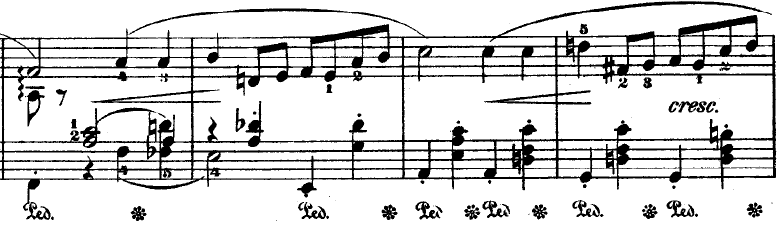
Ped–asterisk notation is the oldest system. The symbol Ped marks where to press the pedal; * marks where to lift it. This was the standard in 19th-century Romantic publishing and remains the system in most Chopin, Schumann, and Brahms editions. The duration of the pedal is implied by the distance between the two symbols on the page.
Bracket notation uses a horizontal line that begins where the pedal goes down and ends with a downward angle where it comes up. A notch in the line (∧) means: lift the previous pedal and immediately press again — standard at every harmony change. Modern publishers increasingly prefer this system because the duration is unambiguous at a glance.
Graded notation appears in some contemporary and performance-edition scores. Half-pedal (1/2), quarter-pedal (1/4), and similar markings instruct the player how deeply to depress the pedal, indicated above the bracket line. This level of specification is rare outside concert-edition editions.
Chopin's Nocturne Op. 55 No. 1 illustrates the Ped–asterisk system in practice. The markings below the bass staff show how the pedal changes at each harmonic unit — typically one pedal per measure, sometimes shorter.
The Soft Pedal — Una Corda and What It Actually Changes
The soft pedal shifts the action of a grand piano so that the hammers strike one or two strings instead of the full three. The Italian phrase una corda — "one string" — gives the pedal its most common score marking, even though modern piano construction means the hammer typically still strikes two strings when the pedal is engaged.
Score markings:
- una corda or u.c. — engage the soft pedal
- tre corde or t.c. — release it ("three strings")
- tutte le corde — equivalent to tre corde
What the soft pedal changes is not only volume but timbre. Because the hammer contacts a different section of the felt, the attack character and overtone content shift. Beethoven exploited this in the second movement of Sonata Op. 111, where una corda lasts for extended passages — the intention was not "play quietly" but "become a different instrument." The pp dynamic is already specified; the una corda asks for a quality of sound that pp alone cannot produce.
On an upright piano, the soft pedal moves the hammers closer to the strings, reducing travel distance and impact. Volume decreases, but the timbral shift is less pronounced than on a grand. Una corda markings in scores assume a grand piano; the effect on an upright is partial at best.
Unlike sustain pedal markings, which change frequently within a passage, una corda typically spans a longer section. The marking holds until tre corde ends it — sometimes across a dozen measures.
The Sostenuto Pedal — Selective Sustain
The sostenuto pedal is the most specialized of the three. When pressed, it catches only the dampers of keys that are already being held down at that moment. All subsequent notes behave normally — they stop ringing when the key is released — but the notes held when the pedal was pressed continue to sound until the pedal is lifted.
Score markings:
- Sost. Ped. — engage the sostenuto pedal
- * or a separate bracket line — release
The typical use case is a sustained bass note or chord that must ring while independent material unfolds above it. A simple sustain pedal would mix everything together; the sostenuto pedal holds only the chosen bass tones while the upper register stays clean. Debussy and Ravel, among others, required this effect in piano works that create organ-like pedal points beneath moving harmony.
The sostenuto pedal appears rarely in 19th-century repertoire because it was not standardized on concert grand pianos until the later decades of that century. Chopin's and Beethoven's scores contain no Sost. Ped. markings. The notation appears primarily in 20th-century works and in instructional editions that explain the three-pedal system.
Reading Pedal Markings in Practice
When pedal markings appear in a score, the immediate questions are:
- Which pedal? Ped or bracket lines → sustain. Una corda → soft. Sost. Ped. → sostenuto.
- Where does it start and end? Match each opening symbol with its closing symbol.
- Is there a re-pedal point? The ∧ notch in bracket notation means lift-and-immediately-press.
- Which edition? The same work can appear in Ped–asterisk in one edition and bracket notation in another; the underlying instruction is the same.
Bruno Repp (1992), analyzing timing microstructure across 28 recorded performances of Schumann's Träumerei, found that expressive details in piano performance — timing, dynamics, articulation — function as integrated systems rather than independent instructions. Pedal markings operate the same way: they do not stand apart from the harmonic and phrase structure but are instructions embedded within it.
Recognizing which category a pedal marking belongs to — sustain, soft, or sostenuto — removes the most common source of confusion. From there, the notation resolves quickly: Ped or bracket lines for the most frequent pedal; una corda for the timbral shift; Sost. Ped. for the selective hold that keeps selected notes ringing. The more automatically notes themselves are recognized, the more cognitive space is available for markings like these. That is one of the practical reasons that note-recognition speed matters in piano sight-reading — not as an end in itself, but as the foundation for reading the full text of a score.