Compare two players.
A: 97% accuracy on a sight-read, but at 70% of the original tempo. B: 92% accuracy at 100% tempo.
Who is better?
This is a trick question. Regardless of the answer, comparing "sight-reading ability" as a single number is the mistake. Sight-reading has three independent dimensions.
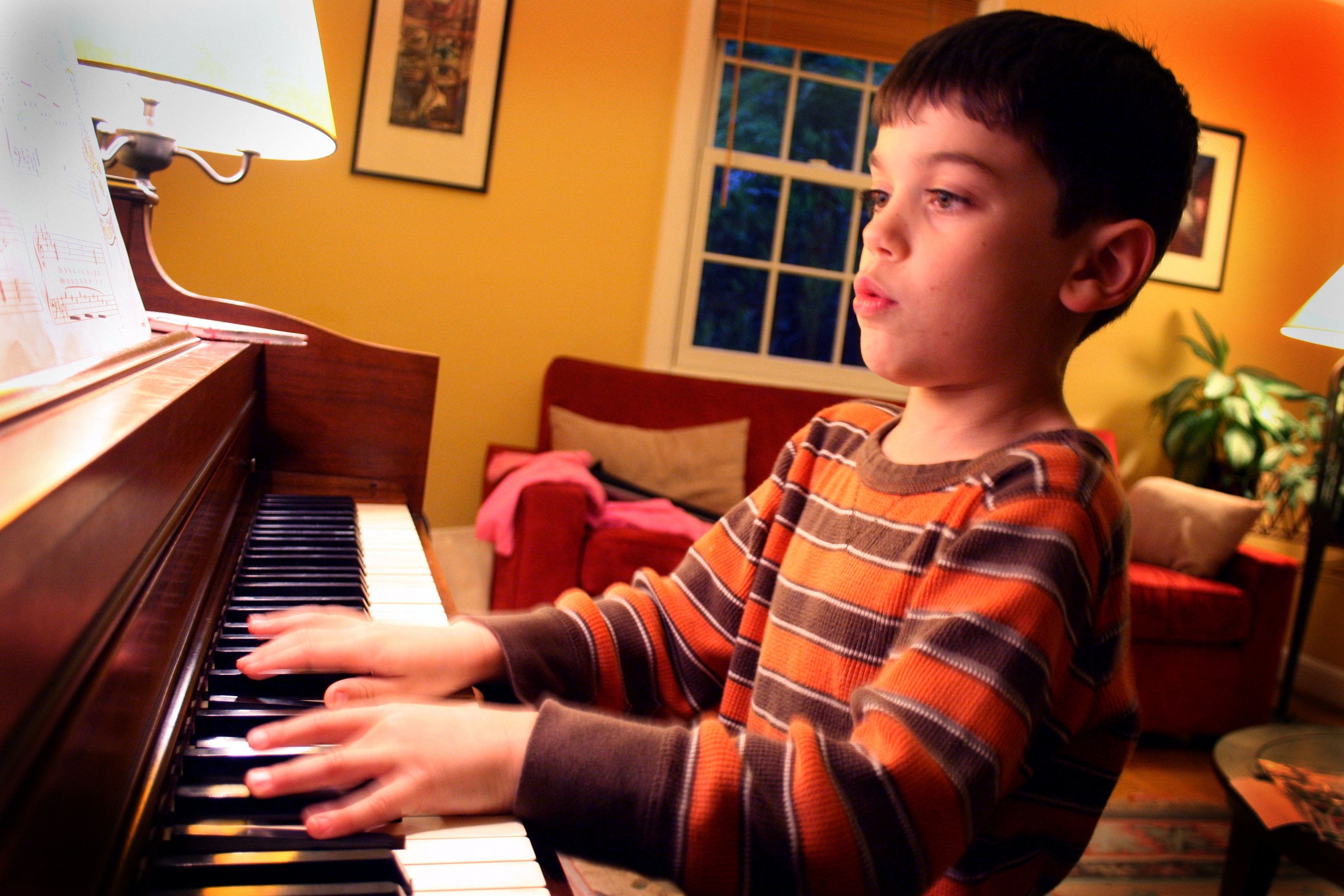 Piano practice. Source: Wikimedia Commons, Public Domain
Step 1: The Three Dimensions
Accuracy
The most common metric. How many of 100 notes were correct.
Pro: Easy to measure. Objective.
Con: Limited. Even 99% accuracy depends on which 1% was missed. Missing the first melody note vs. missing one inner harmony note are not equivalent.
Tempo
Played speed vs. the original tempo. Expressed as a percentage — "60% tempo."
Pro: Musically meaningful. Pieces only become themselves at 100%.
Con: Meaningless without accuracy. 50% accuracy at 100% tempo is just fast mistakes.
Consistency
How stable the results are across five attempts of the same passage. Measured as variance.
Pro: Best indicator of actual learning. A lucky run differs from reliable performance.
Con: Hard to measure. Requires five passes through one piece. Time-consuming.
Step 2: The Trade-Offs
These three are not independent. They pull against each other.
Accuracy ↑ vs Speed ↑: Raising accuracy to 99% requires slowing down. Pushing tempo to 100% forces some accuracy loss. This is a hard cognitive load ceiling.
Consistency ↑ vs Sight-Reading New Material: Improving consistency requires repeating the same piece. But repetition does not build sight-reading ability for new pieces. A trade-off.
Speed ↑ vs Consistency ↑: At higher tempos, consistency drops. At slower tempos, consistency improves.
Because of these trade-offs, maximizing one metric is almost always wrong. You watch the balance.
Step 3: Priority by Stage
The weight of each metric shifts with experience.
Beginner (0–6 months)
Priority: Accuracy
The other two are meaningless. Identifying notes correctly is item one. Speed and consistency come after accuracy is stably above 80%.
Intermediate (6 months–2 years)
Priority: Consistency
If your average is 90%, the next question is whether it's consistently 90% or alternating 95% and 85%. The latter is mostly luck. Consistency leads.
Advanced (2+ years)
Priority: Speed
Accuracy above 95%, consistency stable. Now you push original tempo. Accuracy will temporarily dip when you raise speed. That is normal. It stabilizes at a new equilibrium.
Step 4: How to Measure
How do you actually capture these?
Accuracy
Record. Compare to score. Count wrong notes.
Or use a digital tool. MIDI keyboards with score-analysis software automate this.
Self-measurement is biased. "Close enough" creeps in. Use objective tools where possible.
Tempo
Compare to a metronome. If the original is 120 BPM and you played at 95, that is 79%.
Consistency
Play the same passage five times. Record each attempt's accuracy. Compute standard deviation.
Under 3% — stable. Above 5% — unstable. Above 10% — luck-dependent.
You only need to do this once a week.
Step 5: Build Your Personal Dashboard
Pick a piece each week and record:
| Week | Piece | Avg Accuracy | Tempo % | Std. Dev. |
|---|---|---|---|---|
| 1 | Czerny 599-3 | 88% | 60% | 8% |
| 2 | Czerny 599-3 | 91% | 65% | 6% |
| 3 | Czerny 599-3 | 93% | 70% | 4% |
| 4 | Czerny 599-3 | 93% | 80% | 5% |
What this shows:
- Accuracy and tempo rising together while consistency improves. Good learning curve.
- Week 4 pushed tempo, consistency dropped slightly. Normal.
Without this data, you cannot assess progress. Feelings are not reliable.
Noteflex and the Three Metrics
Noteflex automatically measures accuracy and tempo. End-of-session statistics show both. Consistency is indirectly estimable from accuracy variance across sessions.
Pairing this data against the user's self-perception is core to Noteflex's value. You may feel "today went well," and the data may show "5% below last week's average." That objective feedback is what builds metacognition.
Closing — No One Maxes All Three
No one is perfect across all three dimensions. Not conservatory entrants. Not concert pianists.
The difference is which dimension is stronger, and which trade-offs are made consciously. Players who know their own strengths and weaknesses — and who choose trade-offs deliberately — are the ones who go further.