"I know all the notes. I just can't stay in time." Anyone who teaches sight-reading hears this every week. Note-naming tests come back perfect. Fingerings are memorized. But the second a metronome starts and a new score appears, the pulse falls apart at the first measure. This is not a contradiction. Sight-reading is not the single skill of reading notes — it is the simultaneous operation of vision, cognition, and motor mapping, and a perfectly trained note-reader can still fail when the other two pillars are weak.
In an eye-tracking study contrasting expert and non-expert music readers, Drai-Zerbib and Baccino (2014) showed that the defining advantage of expertise is not raw note-reading speed but cross-modal integration — combining visual, auditory, and motor information in parallel. The expert sees a note, predicts how it will sound, and prepares the finger almost simultaneously. The non-expert runs those three steps in sequence. The pulse can't wait for them.
This article separates the three pillars. Once you know which one is weak in yourself, you know where to spend the next five minutes of practice.
Pillar 1 — Vision: Eyes Ahead of the Hands 👁️
The core of the visual pillar is eye-hand span — how far ahead of the playing position the eyes are looking. In Drai-Zerbib and Baccino's (2014) tracking data, expert pianists ran their eyes one to two beats ahead of the hands. Non-experts looked at the same note their fingers were touching. There is no room left to keep the pulse.
Symptoms of a weak visual pillar:
- Pulse fragility. Each new note triggers a brief stop, because there is no advance read.
- No sense of contour. Reading note-by-note removes the perception of "this phrase rises, that phrase falls."
- No pattern reuse. The same two-measure shape appears twice in the same line, and the second time still feels new.
The most direct training is a deliberate push of the gaze forward by one beat. As fingers play beat one, eyes are on beat two. As fingers move to beat two, eyes are on beat three. It feels impossible at first; a few days of conscious effort makes it natural.
 Figure 1: Eye movement and visual information processing. Vision alternates between fixations and saccades. As music-reading expertise grows, fixation durations shorten and saccade lengths grow. Source: Wikimedia Commons / Public Domain.
Pillar 2 — Cognition: Pattern Recognition and Prediction 🧠
The cognitive pillar is the translation of what you see into musical meaning. When the eyes land on a note, that note can be processed alone ("G") or in context ("the fifth of a V7 chord"). The second is cheaper. Once the note is recognized as part of a chord, the brain stores it as a chunk in working memory rather than as an isolated event.
Symptoms of a weak cognitive pillar:
- Missing accidentals. You see the noteheads but never feel the key or harmony around them.
- Slow adaptation to meter changes. A switch from 4/4 to 3/4 takes several measures to register.
- No generalization between similar pieces. Mastering one piece does not make the next one feel any more familiar.
Training the cognitive pillar cannot be separated from explicit theory study. Visual training alone plateaus without harmony, key signatures, and meter. At the same time, theory without application never reaches working memory. The most efficient method is paired training: study a theory concept, then immediately sight-read a short piece in which that concept appears.
Pillar 3 — Motor: The Fingers Don't Wait for the Eyes 🎹
The motor pillar is the automation of note-to-finger mapping. If the same note is taken by a different finger each time, no automation builds. The hand needs to memorize "this note → this finger" through repetition of stable patterns in a stable register.
Symptoms of a weak motor pillar:
- Eyes already ahead, hands lagging. The head knows the next note; the fingers hesitate.
- New fingering chosen each attempt. Every try feels like the first.
- Pulse collapse in fast passages. Motor automation breaks above a certain tempo.
Motor training has to be deliberately separated from vision and cognition. Drill the same fingering patterns (early Hanon, opening Czerny exercises) inside a metronome until the hand stops asking for confirmation. During this work, don't read new material — the point is that the hand stops needing the eyes for these specific patterns.
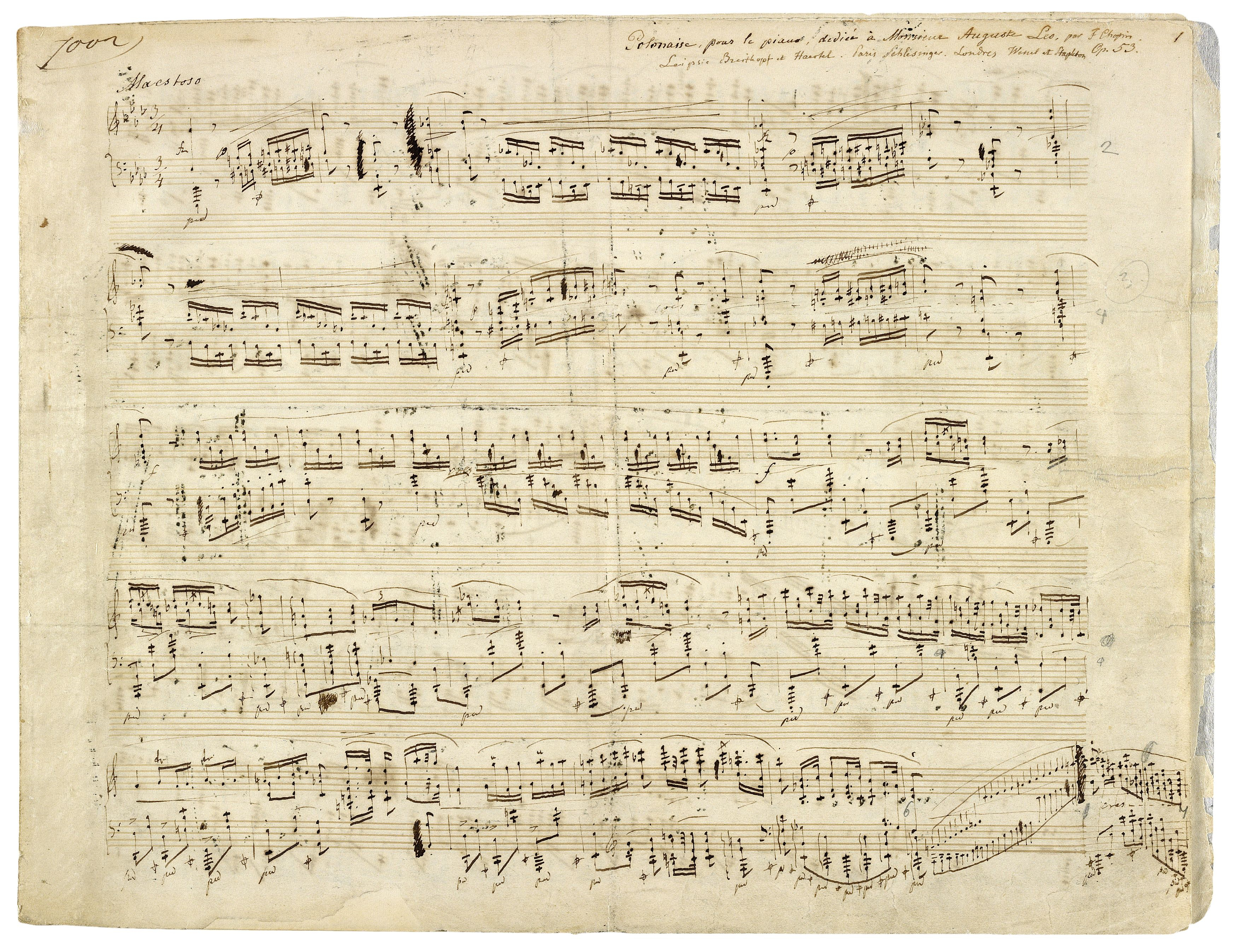 Figure 2: Chopin, Polonaise Op. 53. Where harmonic change, metric accent, and fast fingering pile into a single bar, integration across the three pillars is genuinely tested. Source: Wikimedia Commons / Public Domain.
Diagnosis: Which Pillar Is Weak
A fast self-diagnosis. Prepare two unfamiliar pieces in keys and meters you already know. One should use fingering patterns you've already automated; the other should use harmonic progressions you've already studied.
- Both pieces lose pulse → visual pillar is weak. Eye-hand span training first.
- The fingering-familiar piece flows, the harmony-familiar piece doesn't → cognitive pillar is weak. Theory + pairing training first.
- The harmony-familiar piece flows, the fingering-familiar piece doesn't → motor pillar is weak. Fingering automation first.
The three pillars have to be trained separately, but the final stage always requires integration. Strength in each pillar in isolation does not auto-combine. What Drai-Zerbib and Baccino (2014) showed in their expert group was not higher absolute capacity in any single domain but tighter temporal coupling across all three.
Hit the Weak Pillar and the Curve Moves Again
Most learners stuck on a plateau are evenly training all three pillars and therefore making no concentrated progress on the weak one. Knowing which pillar is the bottleneck lets you spend four of every five practice minutes where it matters.
Noteflex logs accuracy and reaction time per note and per key signature, so the weakness pattern shows up in data. Learners with high accuracy but slow reaction time usually have a motor automation gap; learners with fast reaction time but low accuracy usually have a cognitive pattern-recognition gap. When the dashboard points at the weak pillar, practice stops being a vague routine and becomes a targeted intervention. That is what makes the curve move again.