It is the first morning of rehearsal. The orchestra is seated, instruments tuned. The conductor opens the score. Twenty or more staves stretch down the page: flutes, oboes, clarinets, bassoons, horns, trumpets, percussion, first violins, second violins, violas, cellos, basses. There is no practice run. The downbeat starts now.
The gap between ordinary instrumental sight-reading and full-score sight-reading is not one of quantity alone. Reading a single melodic line or even a grand staff is a fundamentally different task from perceiving twenty simultaneous staves at a glance. The conductor is not reading notes — they are identifying harmonic structure vertically, determining which part carries the melody at any given moment, and scanning ahead to anticipate transitions before any musician plays them.
Reading Vertically
Standard sight-reading moves horizontally: left to right, bar to bar, note to note. Full-score reading requires a different axis of attention. When a conductor sees a new bar for the first time, the eyes sweep downward — from the top wind staves to the low strings — to grasp the harmonic character of the whole bar before progressing to the next. Without this vertical scanning, the score becomes a wall of unrelated lines.
Goolsby (1994) documented the difference between skilled and less-skilled sight-readers through eye-movement data. Less-skilled readers held their gaze on individual notes for longer durations and moved through the score in a near-linear sequence. Skilled readers showed shorter fixations, wider spatial distribution of gaze across the page, and frequent regressions — backward eye movements used to verify harmonic and structural context. In full-score reading, this contrast is amplified further. Vertical scanning is not a refinement; it is a prerequisite.
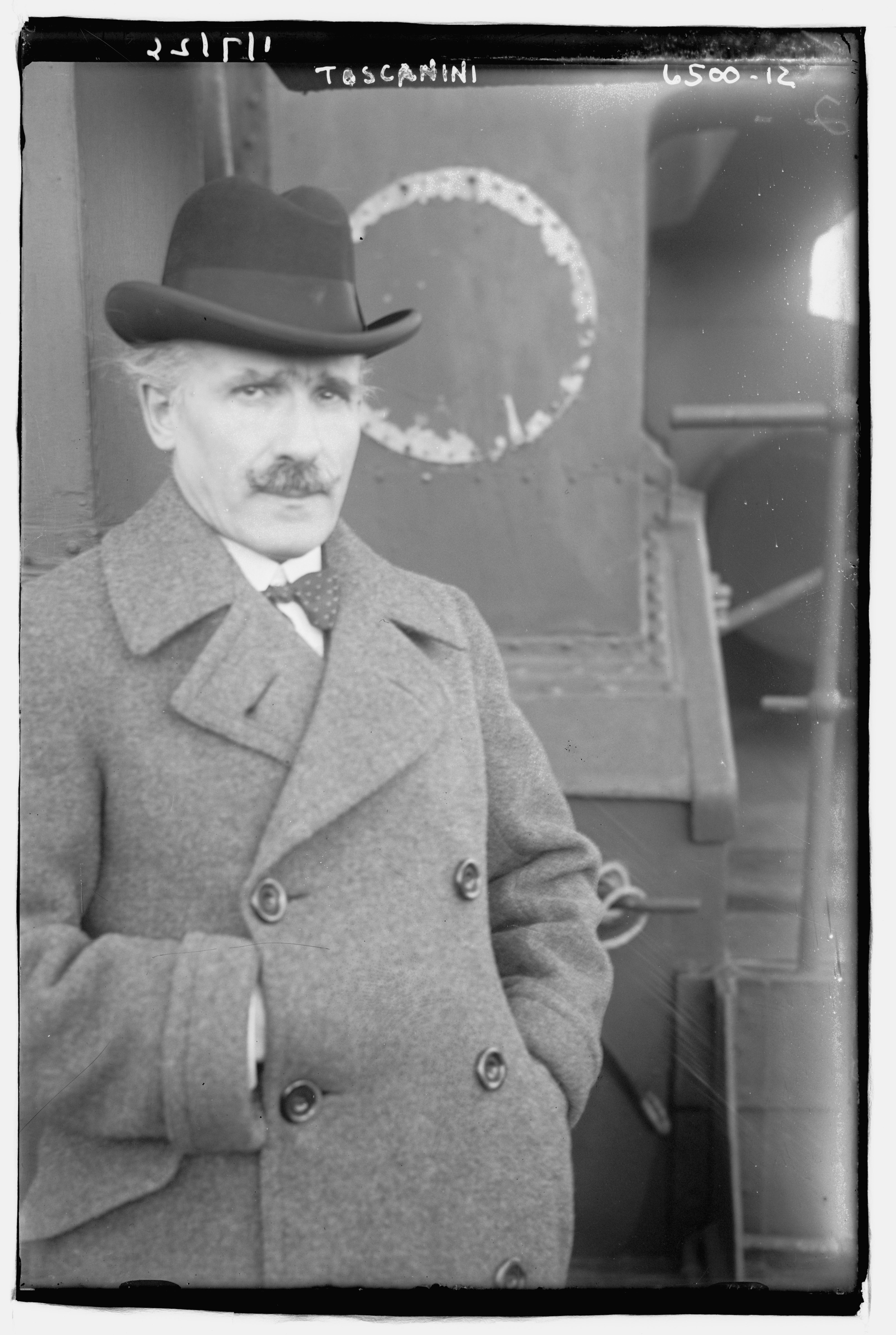 Arturo Toscanini, c. 1900. Library of Congress / George Grantham Bain Collection / Public Domain.
Prioritizing Parts
A conductor cannot give equal attention to every line in a score. Skilled full-score sight-reading involves rapid triage: identifying the melodic lead, the harmonic foundation, and the rhythmic anchor within the first second of encountering a new bar.
Melodic lead: The instrument group carrying the primary theme at that moment. Whether it is the oboe, the first violins, or a horn entering mid-phrase — this line demands immediate identification regardless of where it sits on the page.
Harmonic foundation: The vertical relationship between the bass strings and the mid-register winds, which reveals the key, the chord quality, and whether a modulation is approaching. A conductor who misses this layer loses orientation in unfamiliar music within a few bars.
Rhythmic anchor: The part — often lower strings in pizzicato, or percussion — that establishes and maintains the pulse. Before raising the baton for a downbeat, the conductor must have this anchor internally locked.
Arrangers face the same triage when sight-reading a dense full score to evaluate what can be reduced for a smaller ensemble. The first-pass question is not "what are all the notes?" but "what is structurally load-bearing here?" That is the same skill, applied toward a different purpose: reduction rather than coordination.
Anticipatory Eye Movement
In solo instrumental sight-reading, the eye-hand span describes how far ahead of the currently played note the eyes are reading. Research consistently shows that skilled sight-readers maintain a span of one to several bars ahead, allowing the motor system time to prepare. In full-score conducting, this concept expands further and takes a different form.
The conductor's gaze must be several bars ahead of the ensemble's current position — not because of motor latency, but because preparatory gestures must precede the music they cue. A sudden fortissimo in bar 12 requires a visible upswing by bar 11, or earlier. A tempo transition needs a change in conducting pattern before the musicians physically execute it. Reading what is currently being played is already too late.
This anticipatory window is the last full-score skill to develop. Without it, rehearsals produce a persistent lag: the orchestra sounds together, but just behind the conductor's intentions. Eliminating that lag requires practice with scores specifically chosen for their structural transitions — tempo changes, dynamic extremes, instrument group entries — rather than scores with stable, predictable textures throughout.
A Trainable Skill
Full-score sight-reading can appear to be an innate gift, the product of extraordinary musical memory or lifelong exposure. It is more accurately described as a composite of learnable sub-skills that develop unevenly and in sequence.
The most effective starting point is not a large orchestral score. String quartet and piano trio scores — three or four staves — allow vertical reading to be trained without the cognitive overload of a full orchestra page. As vertical scanning becomes automatic at small ensembles, the part count can expand.
The developmental sequence tends to follow a consistent path. First, harmonic identification from a single cold glance at a bar. Second, melodic-line triage under time pressure, finding the melody among multiple parts without reading every line. Third, maintaining overall flow while the gaze moves ahead of the bar being executed. When all three run without deliberate effort, the conductor's attention shifts from the score to the ensemble — where it needs to be.
The single-line note recognition built through standard sight-reading practice is not separate from this process. Every part in a full score is itself a melody. When individual lines no longer require conscious decoding, the cognitive resources freed by that automaticity become available for harmonic tracking, structural anticipation, and ensemble coordination — the work that full-score sight-reading actually demands.