Beethoven's String Quartet No. 5. Measure one. Four players drop their bows simultaneously.
This simultaneity is no accident. It is the result of precisely synchronized visual signals (the score, the other players' bows), auditory signals (vibrations in the air), and motor output (the bow stroke).
When this synchronization breaks during sight-reading, a quartet becomes four solos.
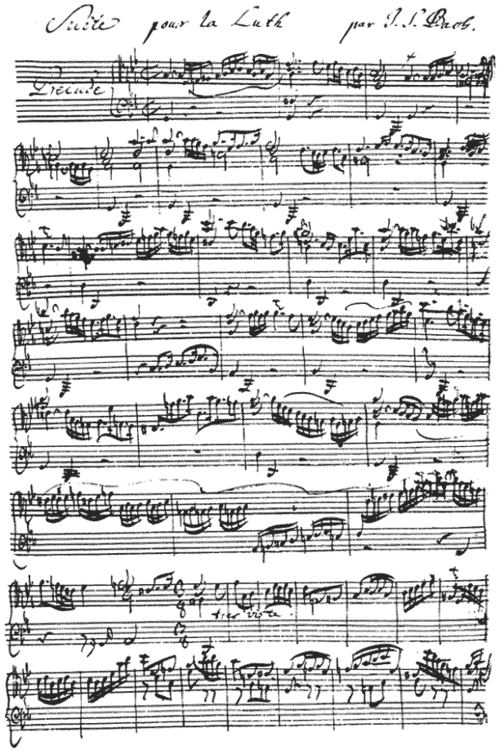 The first page of Bach's Lute Suite No. 1. Source: Wikimedia Commons, Public Domain
The Problem — How Does a Quartet Start in Sync?
A conductorless string quartet. How does the first note arrive at exactly the same instant for four players?
The answer is simple but deep. Visual bowing cues.
The first violin lifts the bow. A small intake of breath. A barely perceptible micro-motion just before the bow contacts the string. This is the "now" signal to the other three.
For the others to read this signal, they cannot look only at their own parts. 90% of vision on the score, 10% on the first violin's bow. Maintaining this ratio is fundamental to ensemble playing.
The Neuroscience of Visual Sync
This visual synchronization connects to the mirror neuron system. Buccino et al. (2001) showed that when musicians watch other musicians perform, their own motor areas activate at the same time.
Watching the first violin's bow movement causes the other three players' brains to respond as if they themselves were moving. This neural synchronization makes the precise simultaneous attack possible.
The system is learned. First-time ensemble players cannot read these visual cues. After about a year of regular ensemble work, the ability forms naturally.
Auditory Sync — Without Listening, There Is No Following
Visual sync alone is insufficient. From the second measure onward, auditory synchronization takes over.
You hear what the others are producing and adjust your timing in tiny increments. Half a beat too fast — slow microscopically. A hair behind — push slightly forward.
This adjustment is not conscious. The auditory feedback loop tunes motor output automatically.
The trouble starts in sight-reading. If almost all your cognitive resources go to your own part, there is no bandwidth left to listen and adjust. The ensemble falls apart.
The fix is straightforward. Only enter an ensemble session with your own part sufficiently automated. If your part is only 60% solid, the auditory loop has nothing to work with.
Bowing Direction — Down-Bow and Up-Bow
A particular string instrument problem: bow direction.
Down-bow (↓) gives a strong attack. Up-bow (↑) gives a softer attack. If two players use different directions in the same measure, the dynamics diverge. The result sounds wrong.
So all bow directions must be unified in ensemble playing. This is bowing.
Some markings are already in the score. Many are not. Typically the first violinist decides bowings in advance for every measure. The others follow.
Sight-reading sessions often have no marked bowings. If each player follows their own instinct, the bowings break. The remedy: agree on the bow direction for the first measure only. The rest follows automatically — once you go down, the next stroke is up by physics.
Five-Minute Pre-Sight-Reading Routine
When a community string quartet sight-reads a new piece:
Minute 1: Confirm meter and key
All four scan the first line. Meter, key, tempo, repeats. One person says aloud: "4/4, A major, allegro."
Minute 2: Agree on the start
First violin says: "Down-bow, one beat in, on the downbeat." Everyone prepares the bow downward.
Minute 3: Flag hazard zones
Each player points to one difficult measure in their own part. "Measure 23 has lots of accidentals, I'll take that slowly."
Minute 4–5: Read the first 8 measures
Slowly. Tempo stability over pitch accuracy. A wrong note here or there does not stop the group. Staying together is the priority.
These five minutes determine the next hour of rehearsal.
Conclusion — Ensemble Is Heard and Seen
Sight-reading in a string ensemble is the sum of two synchronizations.
Visual sync: watching other players' bows, breaths, cues. Some portion of vision always on someone else.
Auditory sync: hearing others and adjusting your own timing. Requires your own part to be automated.
Both are trainable. But neither works without your own part being automated. Automation of your own part is the prerequisite for ensemble sight-reading.
Noteflex and Ensemble Preparation
Noteflex is a solo sight-reading tool. But its output feeds directly into ensemble playing. Only a player who recognizes their part at the pattern level has bandwidth to give other players cognitive attention. Automated pattern recognition → audiovisual sync capacity → musical ensemble. The order does not change.